
Sooner than you’d think, Gen Z is due to become one of the most valuable consumer groups in the world, with an expected spending capacity of $12 trillion by 2030 (NIQ). But before the full weight of that purchase power arrives, the “Zoomer” generation’s unique set of consumer habits have already begun to emerge into view.
Across the latest research, one pattern comes through clearly: Gen Z is making brands earn their place in the budget. Younger consumers are still highly price-conscious, but the bigger shift is that spending decisions increasingly hinge on whether the value feels real, relevant and easy to verify in everyday life. That can mean saving on routine purchases, paying for something trusted or useful, enjoying a small treat, or making room for an experience that feels worth the trade-off.

But of course, understanding any generation’s shared value system needs a bit more nuance than noting their typical likes or dislikes. So looking deeper underneath the latest research, let’s break down Gen Z’s materialising spending habits, their true spending power, how they talk about their chosen brands, and what all this can actually tell us.
What Are Gen Z Spending Habits in 2026?
Gen Z spending habits in 2026 are shaped by a higher burden of proof around what deserves their money. Younger consumers are still highly price-conscious, but the bigger pattern is that purchases increasingly need to justify themselves. A product, brand or experience has to feel genuinely useful, personally rewarding, socially relevant, or clearly worth the trade-off.
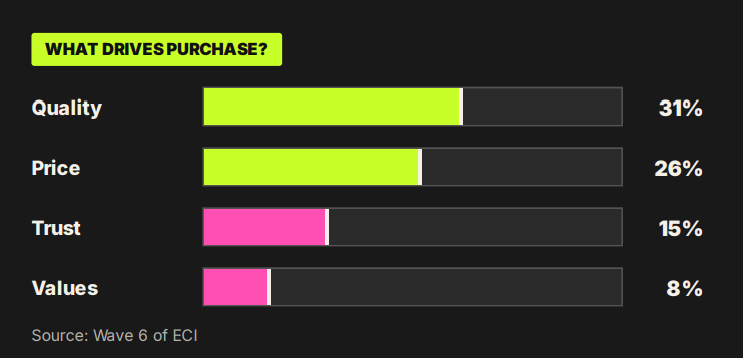
Graph Source: Gen Z Insights 2026 | Emerging Consumer Index | Rival Technology
That is what makes Gen Z's spending habits more interesting than simple frugality. In Rival Technologies' 2026 research, 55% of surveyed young adults described themselves as careful with money while still spending on what mattered to them. In the same research, quality ranked above price as a purchase driver — at 31% versus 26%. Together, those findings suggest that Gen Z is weighing up what a purchase delivers, alongside what it costs.
Gen Z Spending Trends at a Glance
| Spending habit | What the research shows | What it reveals about Gen Z consumer behaviour |
|---|---|---|
| Selective economising | Sales, coupons, resale, dupes and DIY all feature heavily | Everyday spending is actively managed so money can go further |
| Meaningful splurging | Higher-value purchases and experiences can retain spend | Gen Z protects money for things that feel worth the trade-off |
| Cross-environment shopping | Social, AI, ecommerce and physical stores all influence purchase | Discovery moves across environments rather than following one fixed funnel |
| Identity-led purchasing | Customisation, uniqueness and socially visible brands carry weight | A purchase can express taste, affiliation and identity |
| Active brand advocacy | Recommendation and positive word of mouth matter strongly | A customer can create value beyond the transaction itself |
| Experience seeking | Festivals, days out, travel and entertainment over-index in Gen Z interest | Participation and memory can become part of the value being purchased |
Of course, these patterns don't apply to every Gen Z consumer, and they aren't necessarily unique to this generation. NIQ's 2026 research shows that selective spending happens across generations, while Bank of America found that 67% of US Gen Z adults report spending more on goods than experiences. This is where generational marketing becomes useful: recognising shared patterns while accounting for geography, income, life stage and individual priorities. Understanding a generation gives us a useful starting point, with the details showing where those patterns actually hold up.
How Much Spending Power Does Gen Z Have?
Gen Z's spending power is growing fast, with NIQ estimating that the cohort already represents around a quarter of the global population and could command $12 trillion in spending power by 2030. Current household spending still trails older cohorts in many markets, which is unsurprising when the generation still includes teenagers, students, and people at the beginning of their careers. The more important commercial point is the trajectory, and what brands they have relationships with after their income and independence has grown.
Gen Z's Economic Influence Travels Beyond the Transaction
Gen Z's commercial value also extends beyond what appears on a receipt. NIQ found that 74% of Gen Z shoppers look for brands they are proud to display or recommend to friends and family, while 66% look for brands they hear about through positive word of mouth. Another 66% favour brands where people tell their own stories about why they like them.
That turns a purchase into something potentially more valuable: affiliation, recommendation and discovery for the next customer. When somebody buys a product, posts it, talks about it or simply makes the brand visible within their social circle, part of the marketing moves with them.
This gives Gen Z spending a multiplier effect that is worth paying attention to. A brand can earn revenue from the customer in front of it and social proof among people who were never part of the original transaction.
What Influences Gen Z's Spending Decisions?
Gen Z's spending decisions come down to what feels worth paying for, and that can change considerably from one purchase to the next. Price is often the starting point, particularly for essentials, but quality, usefulness, personal taste and enjoyment can all influence the final choice.
That is why Gen Z's spending habits can look contradictory on the surface. The same consumer might hunt for coupons, buy second-hand, treat themselves to coffee, pay more for a product they trust, and still make room for travel or entertainment. The consistency is in how they judge the value of each purchase, rather than what category it falls into.
Gen Z Looks for Savings Where It Can
There's a real financial reason behind much of Gen Z's careful spending. In Rival Technologies' 2026 research, 69% of surveyed young adults weren't confident they could manage a $500 purchase. And PwC found that Gen Z's overall spending fell 13% between January and April 2025, particularly across clothing, accessories and electronics. Affordability is a genuine constraint for many younger consumers.
That pressure shows up in everyday shopping decisions. GWI found that 51% of Gen Z consider price the leading factor when buying household essentials, while two in five actively search for coupons before purchasing. PwC also found that more than 79% wait for products to go on sale. And according to NIQ's 2026 research, 67% of Gen Z consumers believe private-label products are just as good as national brands.
There's a resourceful side to this behaviour, too. McKinsey's 2026 research found that half of Gen Z respondents seek DIY inspiration online, while half buy second-hand every two to three months. These habits offer different ways to stretch a budget, particularly when paying more for a familiar brand or buying something new doesn't seem to offer enough additional value. When a cheaper alternative meets the same need, the premium becomes harder to justify.
Quality, Usefulness and Trust Influence What's Worth Buying
Price doesn't tell the whole story of how Gen Z makes purchasing decisions. When Rival Technologies examined the main purchase drivers among young adults in 2026, quality came first at 31%, followed by price at 26%, trust at 15% and values at 8%. It's a useful reminder that the cheapest option isn't always the one that feels most worthwhile.
NIQ's 2026 research also identifies a gap between what consumers say matters to them and what actually influences their purchases. Gen Z may express support for sustainability, authenticity and brand values, but price, product quality, convenience and cultural relevance can carry more weight when money is being spent. A brand's promises still need to translate into something the customer can recognise and benefit from.
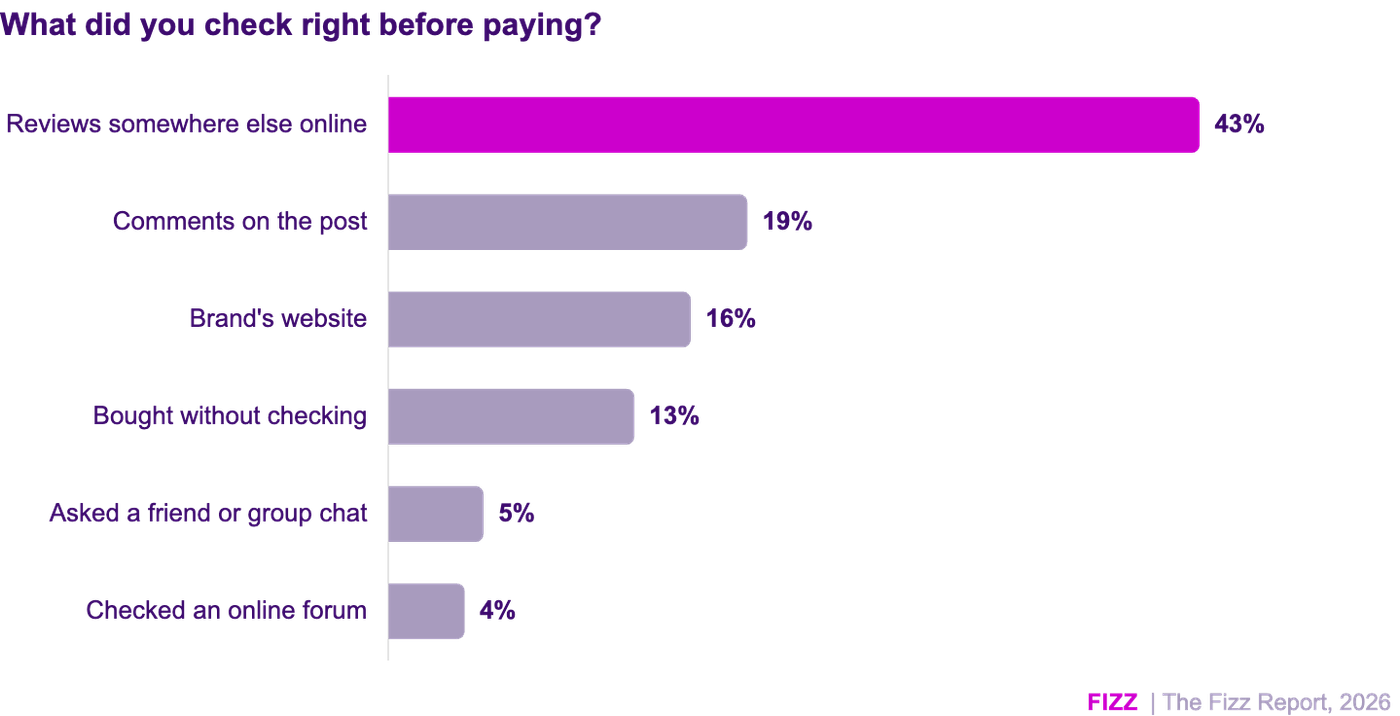
How Gen Z verifies products discovered on social media, from the Fizz Report 2026
Trust plays a part in that decision, too. In a 2026 Fizz study of more than 6,800 US college students, nearly nine in ten checked something before buying a product they'd discovered on social media (such as reviews, asking a friend, or the brand’s site) , while 35% selected detailed reviews as the type of brand post most likely to encourage a purchase. For these shoppers, seeing a product advertised is often only the beginning. They want reassurance that what they're buying will actually deliver.
Small Treats Still Earn Their Place in the Budget
Even when larger purchases feel out of reach, smaller indulgences remain an important part of Gen Z spending. Bank of America's 2026 research found that 92% of surveyed Gen Z adults treat themselves, whether to lift their mood on a difficult day or celebrate something positive. These purchases can be as ordinary as a coffee, a bakery treat or something small to look forward to.
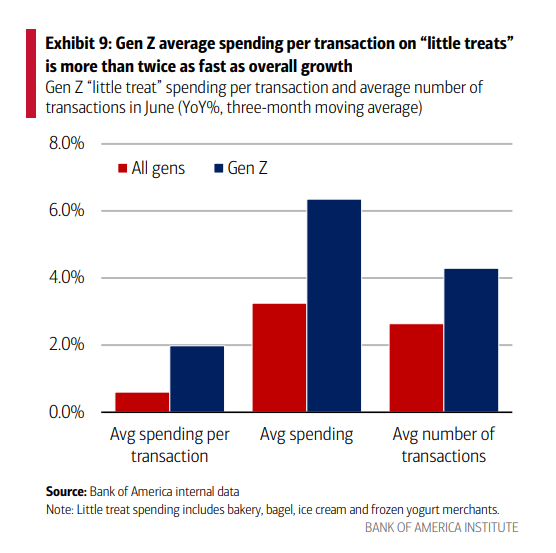
From Bank of America 2026 “The Gen Z reality check” research report
The spending data backs this up. Bank of America found that Gen Z spending at small and mid-sized coffee chains grew more than 25% year-on-year in June 2026. Average spending per transaction across selected small-treat categories was also growing more than twice as fast as the overall rate. Meanwhile, Capgemini's 2026 consumer research found that 71% of Gen Z respondents felt buying treats rewarded their efforts to save elsewhere.
There's an interesting tension here. Gen Z's financial pressures haven't disappeared, but neither has the appeal of a small reward. What makes these purchases worthwhile is often the enjoyment, comfort or sense of occasion they offer. The value can be immediate and personal, even when the amount spent is relatively small.
Discovery and Individuality Can Add Value Too
For some Gen Z shoppers, what makes a purchase worthwhile is finding something that feels more personal. Second-hand shopping is a good example. McKinsey's 2026 research found that younger consumers were drawn to resale for more than affordability. The chance to access premium products, find unusual items or enjoy the search itself also plays a role.
PwC's 2025 research found that 49% of Gen Z consumers wanted customised products, while 63% planned to shop for vintage or upcycled goods during the holiday season. Both findings point to an appetite for products that offer some individuality, whether through personalisation, rarity or discovering something with its own history.
That makes second-hand shopping particularly interesting. Someone might choose resale to save money, but end up finding something more distinctive than they would have bought new. The experience of searching, finding and choosing can contribute to the value of the purchase itself. For brands, it's a reminder that personal relevance and discovery can give people another reason to choose a product.
Experiences Remain a Spending Priority for Some
Experiences are another area where Gen Z consumers show a willingness to make financial trade-offs. Bank of America's 2026 Summer Travel Outlook found that 27% of Gen Z respondents were already taking on, or planned to take on, additional work specifically to afford travel and live entertainment. For those consumers, the experience mattered enough to influence how they intended to earn their money.
That interest takes several forms. GWI found that Gen Z consumers outside the US were 19% more likely than average to spend on experiences such as spa days or days out. And in McKinsey's 2026 research, 12% of Gen Z respondents said they would spend an extra $200 on at-home entertainment, twice the proportion of baby boomers. Experiences can mean travel and live events, but they can also be smaller moments of entertainment, enjoyment or connection.
The important part is what the experience offers the person spending the money. It might be time with friends, access to something special, a chance to participate or simply a break from routine. These are different reasons for finding something worth the cost, and they help explain why certain experiences can remain appealing even when budgets are under pressure.
Where Does Gen Z Shop?
Gen Z shops across social media, AI, ecommerce and physical stores as parts of the same purchase journey. The pattern is fluid enough that “online shopper” and “in-store shopper” do not describe much on their own.
McKinsey's 2026 data found 23% of Gen Z discovered their last new brand through social media, while 28% discovered it in a physical store. Social media becomes even more influential during purchase evaluation, when 34% say it plays a key role, and 28% are already using generative AI tools for shopping. TelmarHelixa reinforces that research role for social, with 46% of Gen Z using social networks for online product research.
PwC finds an equally physical side to Gen Z shopping behaviour. 61% prefer discovering new products in-store, with 41% saying the opportunity to touch and see products is one reason they are increasing their store visits. At the same time, 43% expected to use social media for gift discovery, with social also feeding research and comparison before purchase.
Essentially, Gen Z discovery moves across environments. A product can enter the picture socially, be compared through AI or ecommerce and become convincing once somebody sees it in person. For brands, that makes each environment part of the same decision rather than a separate customer journey.
How Do Gen Z Spending Habits Compare to Other Generations?
Gen Z is not the only generation thinking carefully about value. What stands out is how younger consumers use digital tools, social platforms and peer opinions to discover and assess products before spending. McKinsey's 2026 research found that social media had become Gen Z's leading channel for brand discovery and purchase decisions, although traditional stores remain important too.
The generational differences become clearer when we look at specific behaviours. Research shows that Gen Z places greater emphasis on authenticity and transparency than consumers overall, while its willingness to use social shopping is particularly strong alongside millennials.
| Area | What the research shows | Why it matters for brands |
|---|---|---|
| Brand authenticity | 32% of Gen Z consider authenticity important when purchasing, compared with 24% of consumers overall | Brand positioning needs to feel credible and consistent |
| Brand transparency | 25% of Gen Z value transparency, compared with 16% overall | Clear product information and believable claims help support purchase confidence |
| Social shopping | McKinsey's 2026 research identifies social media as Gen Z's leading channel for brand discovery and purchasing decisions | Brands need to consider how their value is communicated and assessed across platforms |
| Willingness to indulge | 56% of European Gen Z respondents planned to splurge, compared with 39% of millennials, 28% of Gen X and 21% of boomers | Financial caution can coexist with a willingness to spend on selected purchases |
These differences help explain why a traditional brand message may need more supporting evidence when reaching younger audiences. But NIQ's research also makes an important point: consumers across generations are willing to pay more when a product earns the premium and trade down when it doesn't. The useful distinction is how those decisions take shape for Gen Z, and what brands need to demonstrate to earn their confidence.
What Does Gen Z Brand Loyalty Look Like?
Gen Z brand loyalty looks most like active affiliation: people stay with brands they trust, and the strongest relationships become visible through recommendation, conversation and repeat choice.
NIQ found that 63% of Gen Z shoppers say they always buy the same brands they know and trust. More strikingly, 74% seek brands they are proud to display or recommend, while 66% look for positive word of mouth and the same share value stories from other customers about why they like a brand.
There is still plenty of willingness to move when a competing offer creates better value. PwC found 59% prefer known brands, while 41% are willing to buy cheaper private-label alternatives. GWI similarly describes Gen Z as relatively willing to switch brands and finds them 12% more likely than average to say positive social likes and comments would increase their likelihood of buying online.
The pattern is useful for understanding Gen Z brands and loyalty together. Familiarity helps, but the relationship becomes commercially powerful when familiarity grows into advocacy. A trusted brand can get the repeat purchase and gain somebody willing to tell other people why it deserved the money.
Why Experience Is Part of Gen Z's Value Equation
Experience is part of Gen Z's value equation because it can deliver several things this audience already spends for: discovery, participation, product understanding, identity, and memory. TelmarHelixa adds another useful signal here, with recreational activities ranking first among the Gen Z purchase categories it tracks, at 78%. GWI also sees above-average interest in festivals and other experiences, while PwC finds younger consumers returning to stores partly because seeing and touching products still matters.

Roller skating festival experience from the Long Beach Pride C&M case study
This is where experiential marketing becomes commercially relevant. A live brand experience can make value easier to judge by letting somebody taste the product, test it, compare it, understand how it works, or participate in the world around it. When the product itself is familiar, the experience can add another kind of value through discovery, community or the memory attached to being there.
That fits the wider Gen Z spending pattern particularly well because the experience can travel too. A moment worth participating in can become something worth talking about afterwards, connecting the spend back to the advocacy and social proof already visible elsewhere in the research.
Turn Gen Z Consumer Insight Into Experience With Cogs & Marvel
Gen Z spending data becomes most useful when it helps explain what the audience needs to see, feel or understand before something becomes worth their money. That might be direct product proof, a stronger sense of discovery or an experience that gives the purchase meaning beyond the transaction itself.
At Cogs & Marvel, we use those audience behaviours to shape the interaction itself. The goal is to create the conditions where people can understand the brand through what they do with it, whether that means tasting, trying, exploring, participating or sharing the moment with other people.
If you are working out how Gen Z audience insight should translate into a live brand experience, then go ahead and get in touch with our team at Cogs and Marvel.
Gen Z Spending Habits FAQs
What are the main Gen Z spending habits?
Gen Z commonly combines deal-seeking, resale and selective cutbacks with deliberate spending on products, brands and experiences that offer stronger personal, social or experiential value.
How much spending power does Gen Z have?
NIQ and World Data Lab project that Gen Z's global spending power will reach around $12 trillion by 2030.
What does Gen Z spend the most money on?
Gen Z spending varies by market and life stage, but research shows strong interest in experiences, travel, entertainment, technology and purchases that deliver clear value or personal relevance.
Is Gen Z brand loyal?
Gen Z can be highly loyal to trusted brands, with NIQ finding 63% consistently buy brands they know and trust, although this generation remains willing to switch when another option offers stronger value.
Does Gen Z prefer shopping online or in stores?
Gen Z uses both heavily, with social and digital channels shaping discovery and evaluation while physical stores remain an important place to discover, inspect and experience products.