
Gaming Culture and Experiential Design: Understanding Fandom, Identity and Community
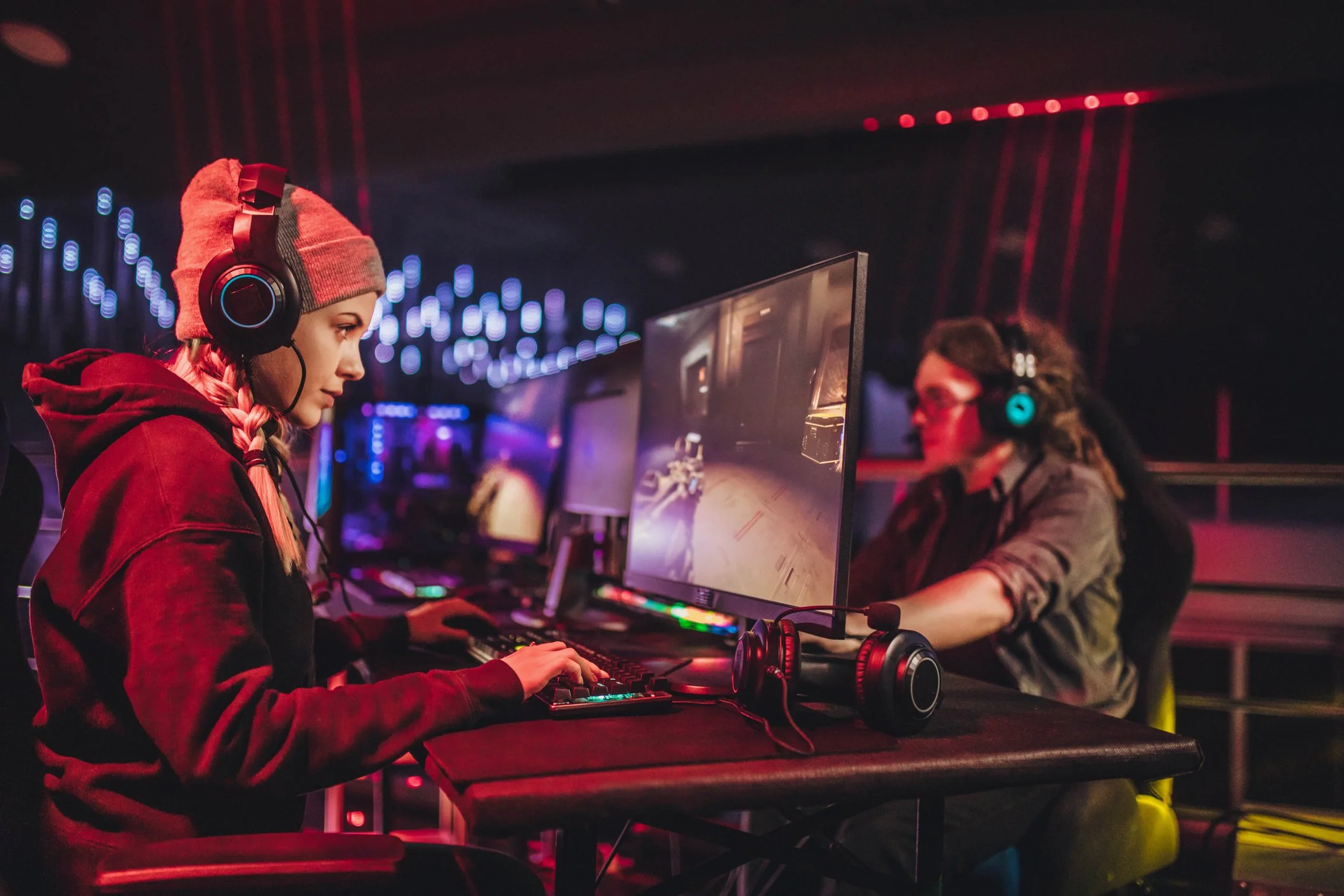
Gaming culture is shaped by diverse motivations, identities and overlapping fandoms, which means there is no single “gamer” audience to design activation experiences for. Effective experiential design starts with understanding why people play and what they value, then translating those needs into real world experiences that offer meaningful participation, choice, connection and authentic worldbuilding. Done well, this can strengthen fan engagement by giving people something the screen alone cannot.
With Gamescom coming up later this month, we’ve been talking a lot at Cogs and Marvel about designing experiences for gaming audiences at events like this. As a marketer, my brain immediately defaults to, what do we know about the audience? So I started digging. A video called Pro Gamers versus Gaming Stereotypes by OpTic Gaming (one of the top Call of Duty competitive teams) caught my attention. The video asks the OpTic team members whether they agree, disagree, or are neutral on a series of questions. One of the questions that stood out to me was, "mobile gamers are not real gamers". The guys have a very colourful debate but in the end the majority agree with Optic H3CZ (Hector Rodriguez) who closes it down with "mobile gamers may be the most gamers. They're not there for anything besides gaming". I wouldn’t have thought that professional, hardcore gamers would see it this way but their POVs got me thinking, what is a “gamer” - really?
Understanding Gaming Culture Beyond the “Gamer” Label
Gaming has become so mainstream that the idea of a single “gamer” profile doesn’t really hold up anymore. Point in case - my husband. On the surface he's a button-up-shirt, private school, corporate kinda guy. But, he’s also an IT nerd who geeks out in the maker community, binge watches anime, and one of his guilty pleasures is DotA 2, a multiplayer RTS (or MOBA depending on who you ask). Not fitting the outdated “gamer” stereotype on the outside at least, I was curious about whether he saw himself as a gamer. His response was unequivocally, "yes, I’m a gamer". To my surprise though, he followed that up with "and so are you! You pull all-nighters trying to take down your nemesis. And, you've spent money on games." I've never thought of myself as a "gamer" but he had a point. It turns out I’m not alone in the universe - Livewire and PMCI Play (2025) found that 64% of weekly players don’t strongly identify with the word “gamer” either, preferring the term “player” instead.
What Motivates Gaming Audiences?
To add more nuance, gaming audiences have vastly different motivations for playing. A 2016 study of more than 250,000 players by Yee, identified motivations like action, social, mastery, achievement, creativity and immersion. Quantic Foundry (2026), drawing on more than 1.75 million profiles, breaks these into twelve motivations, including competition, community, challenge, strategy, fantasy, story, discovery and design.
Now, level this up with some Self Determination Theory, which basically explains why games are fun and why people play them. The theory is used by game devs and breaks the appeal of gaming down into 3 basic psychological needs - competence, autonomy and relatedness. When a game hits all 3 notes the experience is incredibly satisfying.
There’s also an emotional function to gaming that goes beyond basic entertainment. A 2024 Fandom study found that stress relief was the number one reason people played, at 54%. Livewire and PMCI Play (2025) reported that 82% of weekly players use gaming to help cope with stress, anxiety or depression. That number is even higher at 92% for Gen Z.
The large sample sizes and agreement across models applied by different researchers makes a strong case for psychographic audience segmentation. We’ll assume this is already happening at the brand strategy level (or it should be) but it’s just as important at the activation level when designing IRL brand experiences. Before racing off into mechanics, content, or spatial features of the activation, understanding the motivations and needs of the audience is non-negotiable. Segmenting not just the audience but potentially even the experience itself to cater for these nuances could be the difference between a good experience and an epic one. And, just like game characters have health scores players need to maintain, experiential designers should use a similar approach, designing with their audience’s needs and changing states in mind instead of forcing everyone through the same intensity of experience. Think about giving your audience a choice in pacing, sensory intensity and social exposure.
Geek Culture, Fandom and the Gateways Into Gaming
Which brings me to my next question, still related to motivation, but even earlier in the player journey than physically playing the game: how do people get into gaming in the first place and what insight does it give us into them as an audience? Is it always a clear-cut interest directly in gaming, or is it more nuanced?
I've often referred to myself as an undercover nerd, literature being my poison of choice (and a good space opera, I’m looking at you Battlestar Galactica). I don't have time to read epics of epic lengths anymore, but whenever I'm cooking, driving, or have a spare minute, you can bet your last vial of health potion I have a high fantasy audio book keeping me company. The incredible world building, complex magic systems, rich characters, and escapism that attracted me to these books, coupled with an overactive imagination, means that I was naturally attracted to dark fantasy or dungeon crawler ARPGs. So if that was the case for me, is there any data to suggest there are others like me? Is there an overlapping cultural umbrella that offers multiple entry points into the world of gaming?
And yes, there is actually data to support this. A study by McCain, Gentile, and Campbell found that gaming culture is very much part of a broader but connected geek culture. Fandoms span games, anime, comics, sci-fi, fantasy, cosplay, fan fiction creators, e-sports, and even music. You can see the overlap at Gamescom with all the different zones catering for esports, cosplay, creators, music, even board games.
I find board games a particularly interesting entry point into gaming. And I'll illustrate with an anecdotal tale of how the different geek culture fandoms are connected. I'm a huge fan of Brandon Sanderson, and in particular, the Cosmere universe. I cried when Tindwyl died in the first arc of the Mistborn series. I went through all the ups and downs of the Stormlight Archive, including the frustrations with book five (IYKYK). And all throughout, I've lived myself into the Cosmere Universe, imagining what it might be like to be an Allomancer or if I would know the words to speak to become a Knight Radiant of the 4th ideal. Through my frequent visits to fandom.com to brush up on secret histories and Cosmere lore, the algorithm had its all-seeing eye on me and has introduced me to a whole new side quest by revealing that there are also Stormlight archive board games! Stormlight: War for Roshar is dropping later this month and it is absolutely at the top of my Christmas list. I can't wait to take Taravangian on after how he betrayed Dalinar and the Coalition in the books. My point here is that my love of fantasy means that I will spend money on the board game. And if they ever bring out a console or computer game, well, they can take my money for that too.
Identity, Fandom and Fan Engagement In Real Life
In the context of conventions like Gamescom, anime, comic and gaming fandoms share a particularly strong connection as well. A study by Yamato found the core elements of Self Determination Theory (autonomy, competence, relatedness) alive and well across these three fandoms while Tang et. al found that cosplayer identity supports positive attendee interaction and emotional solidarity. It's very common to see gaming characters being cosplayed. As I mentioned earlier, cosplay is a big part of Gamescom. The question is why? The 2024 Fandom study helps explain the underlying connection:
80% of respondents said their gaming personality differs from their offline personality
64% find it easier to be themselves online
46% want their offline presence to resemble their gaming presence more closely.
There’s clearly a strong connection between self-expression and engagement and there’s a bonus for brands who tap into this:
72% of respondents would think more favourably of brands that helped bring gaming identity into real life, with stronger interest among women and non binary players, younger adults and multicultural audiences
What Gaming Culture Means for Experiential Design
So what does all this mean for IRL experiential design targeting gaming audiences?
The most obvious point is that the physical experience needs to offer something that screens can’t. Passion and anticipation might make a fan willing to spend money on travel, wait for hours in lines, put up with crowds, and deal with serious sensory overload but what makes them walk away thinking “that was TOTALLY worth it”?
Maybe the answer lies in the Self Determination Theory I spoke about earlier. Gaming is essentially an experience so if Self Determination Theory works for game devs, then why not for IRL experiential designers?
Take competence first. In a game, competence is that satisfying feeling that you are getting better at something. You solve the puzzle, beat the boss, master the mechanic, finally nail the strategy that has been defeating you. But achievement doesn’t automatically mean competition. Only 18% of players in the Fandom study cited competition as a reason to play, compared with 40% who were motivated by achievement and rank. So slapping a leaderboard onto an activation and calling it gamification is probably missing the point.
In an IRL experience, competence could mean giving people a skill to master, something to discover, a puzzle to solve, knowledge to demonstrate, something to collect, or a personal best to beat. And there should probably also be more than one route to feeling like you achieved something. The hardcore player who has spent 2,000 hours with the title might want a genuine challenge. Someone who discovered the franchise last month probably doesn’t want to be publicly humiliated by them.
Then there’s autonomy. Games are fundamentally built around choice. Even highly linear games give the player some control over what they do, where they look, how quickly they move or how they solve a problem.
In a physical setting the question becomes: how much agency does the audience have?
Can they choose what to explore? Can they personalise something? Can they decide whether they want to compete, collaborate or just watch? Can they go deeper into the lore if that’s their thing, or move quickly to the playable demo if it isn’t? Can they control their own pace, sensory intensity or social exposure?
And then we get to relatedness. Gaming might happen on a screen, but so much of what surrounds it is social. People form teams, argue over lore, watch streamers, join Discords, create fan art, cosplay characters, collect merchandise and travel across countries to stand in a giant hall with thousands of other fans.
Research on gaming and esports suggests that social affiliation and relationship motives are important drivers of fan engagement and advocacy. Shared reveals, collaborative challenges, creator encounters, live performances and even the conversations that happen while people wait can become part of the value of being there.
This is also where worldbuilding, sensory design and authenticity make an entrance.
If people have travelled to spend time inside a world they know and love, then the physical experience should respect that by nailing every little detail of that world. The sound design. The music. The visuals. The characters. The hidden references that somebody who has played every instalment will catch immediately and somebody newer can just enjoy the environment. Could scent be introduced to add a whole new layer that could only be experienced physically?
Research into gaming brands and esports sponsorship points to the importance of cultural fit, credibility and whether the brand is actually adding something useful to the community.
Which brings me back to where I started.
What is a gamer, really?
My husband is one. Apparently I might be one too. So is the guy who has been playing competitive Call of Duty for fifteen years, the mom on Candy Crush, the cosplayer dressed as her favourite game character, the fantasy obsessive waiting impatiently for a Stormlight board game, and potentially a whole load of people who play every week but would never use the word gamer to describe themselves.
There is no neat answer, and maybe that’s the point.
If the audience is this diverse, then designing for “gamers” as if they are one demographic was probably never going to work.
But competence, autonomy and relatedness give us a useful place to start. Give people something meaningful to do. Give them some control over how they experience it. Give them ways to connect with the people and worlds they care about.
Then make sure the world feels authentic enough that when they finally leave the hall, tired, overstimulated and probably carrying far too much merch, they still think:
That WAS totally worth it.
-
Experiential design for gaming audiences needs to account for the fact that people are used to agency, progression, participation and richly developed fictional worlds. A strong physical experience should therefore do more than reproduce the visual identity of a game. It should give people something meaningful to do, choices in how they participate, opportunities to connect with others and a world that feels authentic to the source material.
-
Brands should look beyond demographics and the label “gamer” and consider why people play. Motivations can include achievement, mastery, creativity, competition, community, exploration, immersion and stress relief. These differences can influence everything from the level of challenge in an activation to pacing, social interaction and sensory intensity.
-
Gaming culture overlaps with wider fandoms including anime, comics, fantasy, science fiction, cosplay, esports and creator culture. People may enter gaming through any of these interests, which means brands should think about the identities, communities and cultural references their audiences bring with them rather than treating gaming as an isolated category.
-
Live experiences can create value by offering things that are difficult to reproduce at home, such as collective moments, creator access, physical worldbuilding, social interaction and opportunities for fans to express their identity. The strongest experiences give people a genuine reason to be there rather than simply recreating something they could already do on a screen.
-
Authenticity comes from understanding the world, the audience and the culture around it. Details such as sound, music, characters, materials, hidden references and the way people interact with the experience all contribute. For knowledgeable fans, cultural accuracy and a credible role for the brand matter more than simply applying gaming graphics or technology to an exhibition space.